
Top Signs You Need Garage Door Service – Don’t Ignore These
The signs you need garage door service almost always show up weeks before the door actually quits. A door that takes two seconds longer to open than it did six months ago isn’t “getting slower.” It’s telling you the spring tension is off and the opener motor is compensating by working harder than it was built to. The grinding, the slight drift to one side, the hesitation at the top of travel: those are early mechanical warnings, not personality quirks. This post is about catching them while the fix is still a scheduled appointment instead of a Sunday morning scramble with a car trapped inside.
And if you’d rather not climb a ladder with a flashlight, that’s fine. Call (877) 820-9302. We answer 24/7. Fast dispatch from 7am to 7pm, Sunday through Friday.
Key Takeaways
- Slow, uneven or jerky travel is a spring and cable warning, not an opener problem.
- A sharp “crack” or metallic “snap” means stop using the door immediately.
- A door that fails the 30-second balance test needs spring or track attention.
- Intermittent reversal is usually a photo eye that drifted, not a dying motor.
- Spring work is not a DIY repair. That’s the one sign you never sit on.
1. Your Door Opens Slower, Jerkier, or Unevenly
Uneven travel, where one side of the door climbs faster than the other, is the most misread sign in the trade. Homeowners assume the opener is tired. Usually the opener is doing exactly what it was told and covering for a torsion spring that has lost tension or a cable that has started to walk off its drum. Because the door itself is a balanced system, a small imbalance means one side is now carrying more weight than the other, and the motor takes the difference on every single cycle. Wear accelerates on the cable, the drum and the opener’s gear assembly at the same time.
What to look for in Jupiter:
- The door hesitates at the start or stalls slightly at the top of travel.
- One side visibly lags. Watch the gap between the door and the frame on each side as it rises.
- The door jerks or shudders rather than gliding.
- The opener sounds strained, or the motor housing feels warm after a few cycles.
Get this looked at while it’s still a repair. Left alone, uneven travel turns into a snapped cable or a broken spring, and that’s a very different phone call. Our garage door repair work starts with a balance and tension check for exactly this reason.
2. Listen to the Sound: Fraying Cable vs. Dry Roller
Your ears are a better diagnostic tool than most homeowners realize. A dry roller squeals. A cable about to fray pops and snaps. Those are two very different sounds with two very different urgency levels.
- Dry roller or hinge: a high, steady squeak or chirp that follows the door’s rhythm. This is usually a lubrication issue and rarely urgent. It’s the door’s way of asking for a little attention.
- Fraying cable: a sharp metallic “pop,” “ping” or occasional “snap” that happens at a consistent point in the travel, often near the drums at the top corners. Cables are under heavy load and they fail without warning once strands start breaking.
- Spring under stress: a low groan, or a loud “crack” that sounds like a gunshot from the garage. If you hear that, stop and don’t run the door.
If you hear the sharp snap or the gunshot crack, don’t keep cycling the door. Torsion and extension springs store an enormous amount of energy, and a cable under that load can do real damage to a person. Spring repair is not a DIY repair. Call (877) 820-9302 and we’ll get eyes on it.
3. The Door Sticks on Cold Mornings
When Jupiter gets one of its rare cold snaps, a lot of doors suddenly stick, drag or reverse on the way down. That’s not the opener misbehaving. Nine times out of ten, it’s weatherstripping compression failure. The rubber seal along the bottom and sides of the door hardens in cooler air and doesn’t spring back the way it does in the heat. It binds against the frame and the floor, and the opener reads that resistance as an obstruction. Hence the reversal.
How to check yours: run a hand along the bottom seal. If it feels stiff, cracked or flattened instead of springy, it’s time to replace it. Look at the side seals for gaps where the rubber has pulled away from the frame. A torn or compressed seal doesn’t just cause sticking. It also lets in rain, insects and the occasional determined lizard. Replacing weatherstripping is one of the simpler service calls we make, and it heads off a lot of false “my opener is broken” diagnoses.
If the sticking only happens when the door is most of the way down and the seal looks fine, that points back to travel limits or a tension issue. That’s a technician call rather than a DIY fix.
4. Run the 30-Second Balance Test
This is the single most useful check a homeowner can do, because it tells you whether the door’s springs are still doing their job. Here’s how it works, in general terms:
- Close the door and disconnect the opener using the emergency release pull cord. That’s the red handle hanging from the rail.
- Lift the door by hand to about waist height.
- Let go and watch what it does.
What the door tells you:
- Stays put: balanced. The springs are doing their job.
- Slides down on its own: springs have lost tension. The opener is doing the heavy lifting and will eventually pay for it.
- Rises on its own or feels extremely heavy: over-tensioned or misadjusted. Also a problem, just a different one.
The door should lift with one hand and feel light, roughly the weight of a loaded grocery bag. If it feels like a wrestling match, don’t force it. Reconnect the opener and get it looked at. This test is free, takes 30 seconds, and it’s the best early warning system you have. If your door fails it, that’s a spring issue and the right call is garage door spring repair.
5. Your Door Reverses for No Reason
Intermittent reversal, where the door goes halfway down and decides to go back up, gets blamed on the opener almost every time. In practice, it’s usually the photo eyes. These are the two small sensors near the floor on either side of the door. They talk to each other on an invisible beam. When the beam gets interrupted, the door reverses for safety, which is exactly what it’s supposed to do.
What drifts them out of alignment: vibration from the door itself, a bumped trash can, a broom handle knocked against the bracket, or just time and a slightly loosened mounting screw. Dust and cobwebs on the lens are another regular culprit. If your door reverses on one side, or only sometimes, check the eyes first. Look for a solid LED on each sensor. If one is blinking, the beam is broken or the sensors aren’t seeing each other. Wipe the lenses, look for an obstruction, and gently nudge them back into line.
If they’re lined up and clean and the door still reverses, it’s time for professional eyes on it. That’s when we start checking travel limits, the safety reverse force setting and the opener’s logic board. We work on LiftMaster and Genie systems regularly, and this is garage door opener repair territory, not a whole new opener. A good technician diagnoses; a bad one sells you a motor you didn’t need.
6. The Door Looks Crooked, or the Panels Are Stressed
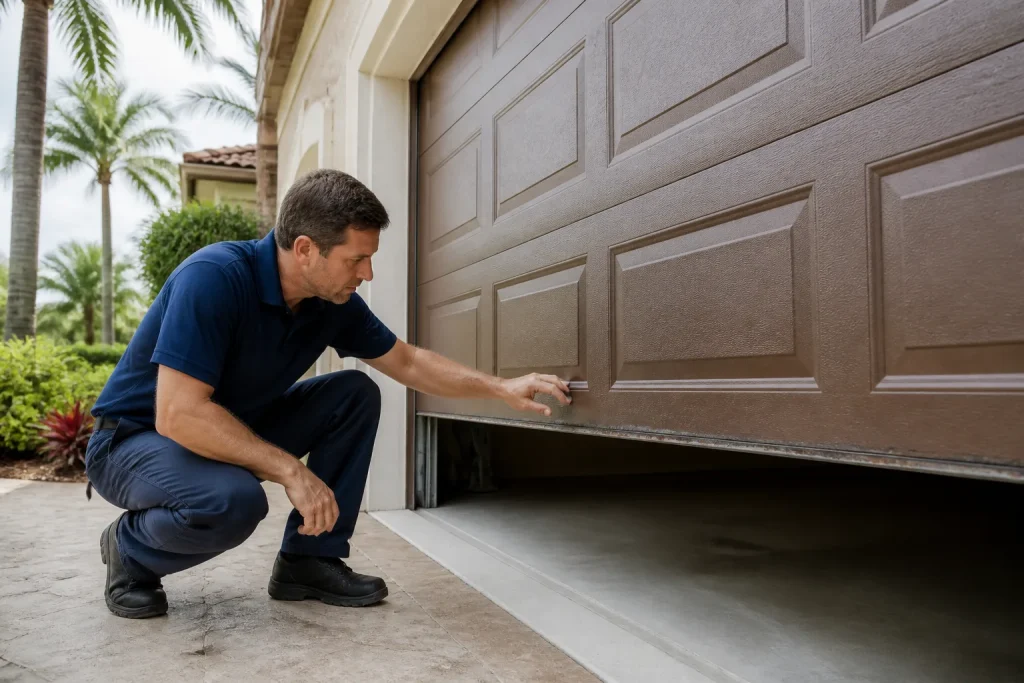
A door that’s visibly crooked, or one with a gap along one side when closed, is often a track problem rather than a panel problem. Tracks get bent by a bumped car, a misjudged bike handlebar or a door that’s been reversing against an obstruction. A bent track forces the rollers to fight the door and the door to fight the opener. The wear shows up on the rollers first, then the hinges, then the panels themselves.
What to check in Jupiter: look at the vertical tracks on each side. They should be straight and parallel. Run a hand along them for dents. Look at the horizontal tracks near the ceiling for bends or sagging. Look at the hinges and rollers for cracks. If you see any of these, stop cycling the door and get a technician out. The good news: straightening tracks and replacing rollers is quick. The bad news: running a door on bent tracks long enough will warp panels, and panel replacement is more than track repair. We work on Clopay door systems all the time, and panel replacement is a real cost when the track has been ignored too long.
When to Call a Pro
Some of these signs you can check yourself. Some of them you absolutely should not touch. Here’s the line: if it involves the springs, the cables, the drums, or anything under load, call a technician. If it involves a squeak, a dirty lens or a worn seal, that’s reasonable DIY territory. Spring work is where the serious injury risk lives, and it’s the reason we treat garage door spring repair and cable work as the core of what we do.
When to call:
- The balance test fails.
- You hear a sharp crack or snap.
- The door travels unevenly or jerks.
- The door reverses and cleaning the photo eyes didn’t fix it.
- Panels are cracked, or the door is visibly off track.
- Your car is stuck inside, or the door is stuck open and the house is unsecured.
That last one is why emergency service exists as a real tier of what we offer. A door stuck open in Jupiter doesn’t just inconvenience you, it leaves your home exposed. If that’s happening right now, call us and we’ll book the soonest opening. Our technicians have up to 8 years of experience, and we service Raynor, Craftsman and the other major systems already on your home rather than pushing a brand we prefer.
Related services in Jupiter: garage door repair, garage door opener repair, and garage door spring repair. For new door projects or remote and smart-home controls that need attention, our technicians handle both ends of the system in one visit.
The Bottom Line
The signs that matter most are the quiet ones: a door that’s a hair slower, a slight lean to one side, a grind that wasn’t there last spring, a door that fails the balance test. These are the door telling you the springs and cables are working harder than they should be, and the fix is a scheduled repair rather than a stuck car and a scrambled morning. Some of them you can check with a flashlight and 30 seconds. The spring work you shouldn’t touch, full stop.
We’re a garage door specialist, not a general handyman service. Every tool and every technician is focused on one trade, which is why we can diagnose the actual mechanical cause instead of guessing at the symptom. If you’re in Jupiter and need help, Jupiter Garage Door Repair Pros offers free estimates. Call (877) 820-9302. We answer 24/7. Fast dispatch from 7am to 7pm, Sunday through Friday. The price is quoted and agreed before any work starts, and the written estimate is what you pay.
One more thing: if you call and tell us the door “just seems tired,” we will absolutely understand what you mean. We’ve heard it every way it can be said.
Frequently Asked Questions
How do I know if my garage door spring is broken?
Usually you’ll hear a loud crack or snap, then the door won’t lift at all or lifts only a few inches before stopping. The opener will run, but the door won’t move well. You may also see a visible gap in the spring coil. If you suspect a broken spring, stop using the door and call a technician. A broken spring is under load and not safe to handle. Call (877) 820-9302 for a free estimate.
What does it mean when my garage door opens unevenly?
Uneven travel, where one side climbs faster than the other, usually means spring tension is off or a cable has started to slip on its drum. The opener then carries the imbalance on every cycle, which wears out cables, drums and the opener’s gears faster than normal. It’s an early warning sign, and it’s fixable. Call (877) 820-9302 and we’ll take a look.
Why does my garage door reverse for no reason?
Most of the time it’s the photo eyes. Check that both sensors have a solid light, wipe the lenses, and look for anything blocking the beam. Vibration and time knock them out of alignment. If they’re clean and lined up and the door still reverses, the issue is in the opener’s travel limits or safety reverse force. That needs a technician. Call (877) 820-9302 for a free estimate.
Should I call for service if the door just feels slower?
Yes. A door that’s climbing slower than it was six months ago is telling you the spring tension has weakened and the opener is doing more of the work. Catching it now usually means a smaller, scheduled repair instead of an emergency call when the spring finally lets go. Call (877) 820-9302. We answer 24/7, and estimates are free.
Written by the team at Jupiter Garage Door Repair Pros.
Need Garage Door Help?
Call Jupiter Garage Door Repair Pros - the local pro we connect you with is licensed and insured, here with fast help in Jupiter.
(877) 820-9302